

When Mary Found “Nothing”… and Everything
Mary Magdalene went to the tomb expecting to grieve. She did not expect her whole world to change in a single morning.
The sky was just beginning to bleed from black to gray when Mary Magdalene slipped through the quiet streets. It was that fragile hour when night had not fully surrendered and day had not fully arrived. Everything felt uncertain. The air was cold enough to bite her skin, but she hardly noticed. Grief numbed her fingers, her feet, and her chest. All she could feel was the empty ache where Jesus used to be.
She had watched Him die. She had stood near the cross when others ran. She had heard His last cries, seen His body broken, seen His blood drip into the dust. The One who had once looked at her with pure, steady eyes and driven seven demons out of her was gone. The man who had called her by name when everyone else called her “unclean” now lay cold behind stone. Or so she thought.
Every step toward the tomb whispered the same quiet promise in her mind: At least I can be near His body. At least I can finish what death interrupted. At least I can love Him one last time with spices and tears.
The Stone That Shouldn’t Have Moved
Then she saw it.
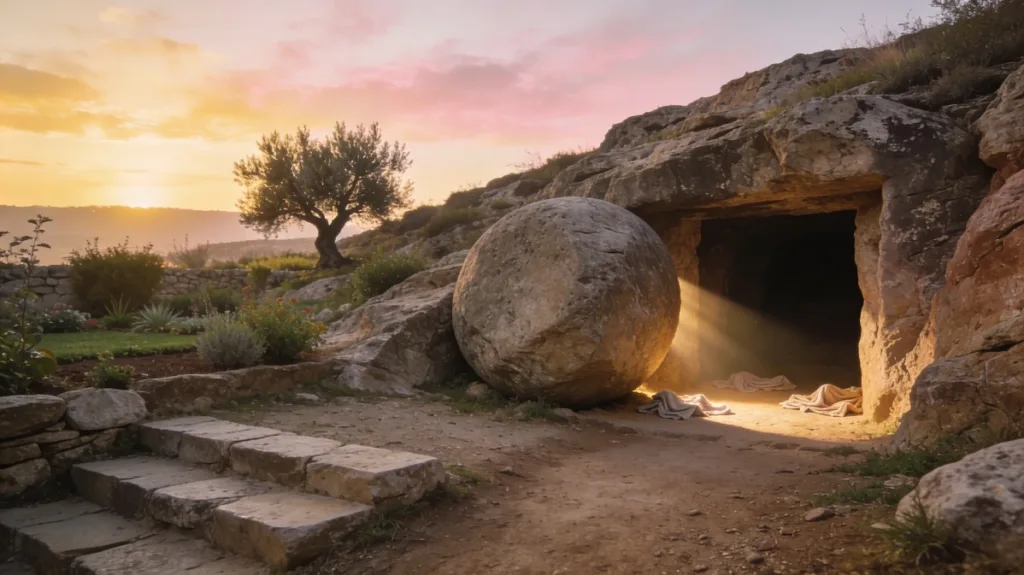
“Someone had rolled the stone away. Not cracked, not slightly shifted, but completely moved aside
Mary froze. Her heart slammed against her ribs. The place that was supposed to hold her last connection to Jesus felt violated, wrong, and empty. Graves don’t open by themselves. Stones don’t politely roll away.
Panic surged through her veins. It wasn’t just fear that His body was gone. It was the feeling that someone had stolen the last piece of her hope. First the cross had taken His life, and now somebody had taken His body. It felt cruel, like the universe was mocking her pain.
She turned and ran. Sand flew from under her feet as she raced back through the streets, lungs burning, tears blurring her sight. When she found Peter and John, the words stumbled out of her mouth in fragments: “They’ve taken the Lord out of the tomb, and we don’t know where they have put Him!”
The Men Leave. Mary Stays.
Peter and John sprinted to the tomb. John got there first but hesitated at the entrance. Peter crashed right in, breathless, scanning the scene: the linen cloths lying there, the burial cloth that had been around Jesus’ head folded up and placed apart. Nobody. No explanation. Just silent evidence that something unimaginable had happened.
John finally stepped inside, saw it for himself, and believed something had happened—though neither of them fully understood yet that the Scriptures had said Jesus must rise from the dead. Confused and shaken, they did what many of us do when God’s actions don’t make sense: they went home.
Mary did not.
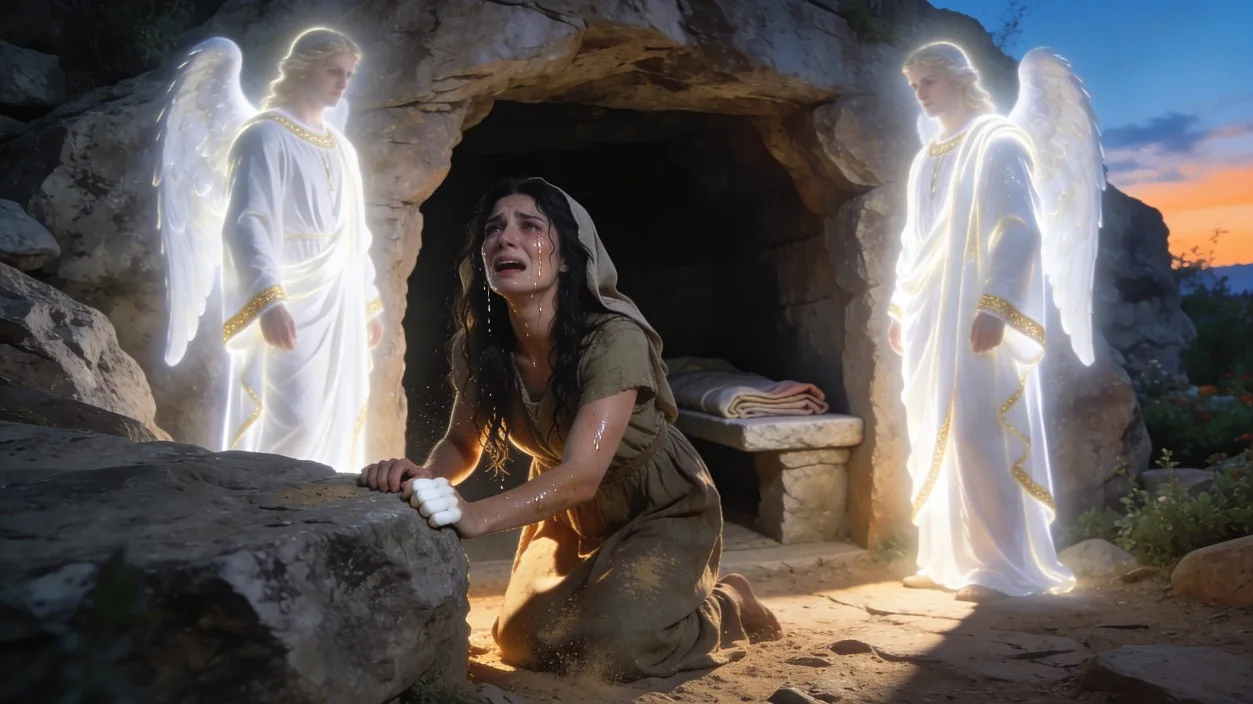
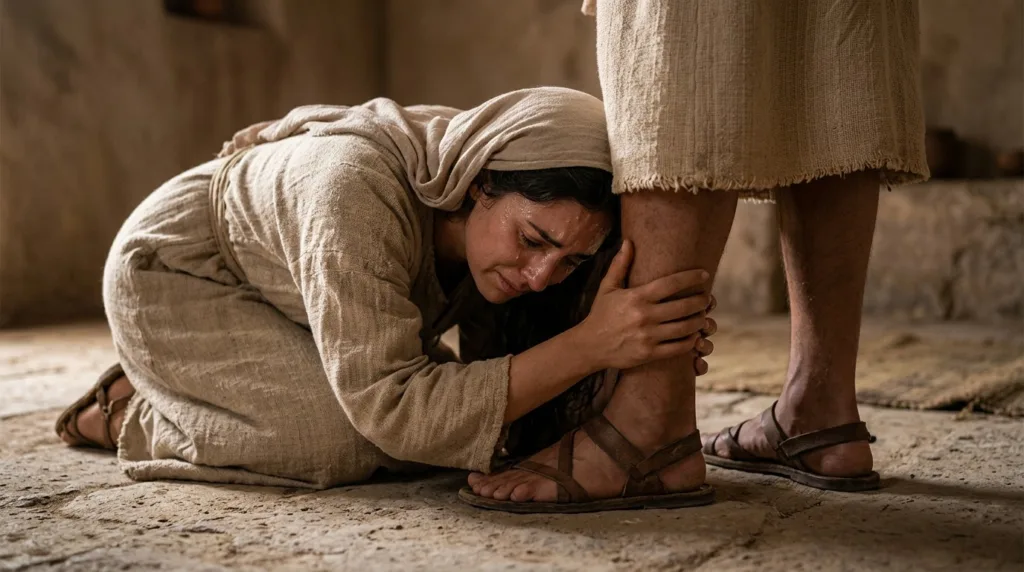
She went back to the tomb. She stood outside, alone, with her chest heaving and tears pouring down her face. The Greek word used for her weeping suggests loud, uncontrolled sobbing — the sound of a heart that has been ripped open and doesn’t know how to close again.
This wasn’t just about a missing corpse. This was about everything she thought God had promised. Every miracle she had seen. Every word Jesus had spoken over her shame‑filled life. Every moment He had defended the broken, touched the unclean, and made the outcast feel seen. Now even His dead body was gone.
In that moment, Mary’s faith looked like a pile of shattered glass. And still, she stayed. She didn’t have answers, but she remained in the place of her pain. That stubborn love — the choice to stand and weep outside the tomb instead of numbing her heart and walking away — became the doorway to the greatest encounter of her life.
“Woman, Why Are You Weeping?”
Mary bent over and looked into the tomb again, desperate for any clue, any sign, any reason. This time, she didn’t see only cold stone. She saw light. Two figures in white, dressed like lightning in human form, sat where Jesus’ body had been—one at the head and one at the foot, like living bookends around a miracle.
“Woman, why are you crying?” they asked.
It almost sounds cruel unless you realize that Heaven asks questions not because it doesn’t know the answer but to pull our real hearts to the surface.
“Because they have taken away my Lord,” she choked out, “and I don’t know where they have put Him.”
Notice the words she uses: my Lord. Grief did not erase her relationship with Him. Confusion did not change who He was to her. She didn’t understand, but she still called Him Lord. That’s what love does in the dark—it keeps saying His name even when nothing makes sense.
Blinded by Tears, Standing in Front of Life
Mary turned around, and through her curtain of tears she saw a man standing there. Just a shape in the early light. She was raw, exhausted, and blinded by sorrow. She assumed he was the gardener. Of course he was. Who else would be walking among tombs at dawn?
“Woman,” he said, “why are you crying? Who is it you are looking for?”
Those words cut deeper than she knew. She thought she was looking for a dead Jesus. Heaven knew she was about to meet the living One.
“Sir,” she pleaded, desperate and stubborn all at once, “if you have carried Him away, tell me where you have put Him, and I will get Him.” She had no idea how she would carry a man’s body by herself. Love doesn’t always calculate logistics. It just refuses to let go.
Then everything changed with one word.
He didn’t preach. He didn’t argue. He didn’t correct her theology. He simply said her name.
“Mary.”
That was the moment heaven broke through her grief. Her knees weakened. Her breath caught. Her heart recognized what her eyes had missed. The sound of her name in that voice — the same voice that had once driven darkness out of her mind and shame out of her story — cut through layers of sorrow in a second.
She spun toward Him fully, and this time she saw. Not a gardener. Not a stranger. Not a memory. Jesus. Alive. Standing. Looking straight into the face of the woman who thought she had lost Him forever.
“Rabboni!” she cried—"Teacher! "—stumbling forward, reaching for Him, clinging to the only solid thing in her collapsing world. Joy and shock and holy fear collided in her chest. Death hadn’t just blinked. It had lost.
A New Mission in the Middle of Tears
“Do not hold on to Me,” He said gently, “for I have not yet ascended to the Father. Go instead to My brothers and tell them, ‘I am ascending to My Father and your Father, to My God and your God.’”
In a breath, Mary Magdalene went from weeping mourner to commissioned messenger. The same woman whose testimony courts would have considered weak became Heaven’s chosen first witness of the resurrection. If the disciples were going to invent a cleaner story, they would never have picked a woman like Mary as their star eyewitness—and that makes her story all the more believable.
Mary Magdalene left the garden with tear‑stained cheeks and a trembling voice, carrying the most explosive sentence history has ever heard: “I have seen the Lord.”
She had walked into that morning thinking hope was buried and sealed behind rock. She walked out of it realizing hope was standing right in front of her, speaking her name.
What Mary Magdalene at the Empty Tomb Means for You
Maybe you feel like Mary in the gray hour before sunrise. Not fully in the dark anymore, but not fully in the light either. You move through your days with a quiet ache. Something died: a dream, a marriage, a calling, a friendship, your sense of worth. You keep walking back to the “tomb” of that loss, not because you expect a miracle, but because you don’t know where else to go.
You stand outside your own tomb—a divorce, a failure, an addiction, a secret sin, or a diagnosis— You look at the emptiness and assume it means God has abandoned you. What you loved is gone. What you prayed for didn’t happen. You don’t see angels; you don’t hear voices. You just see a stone that’s been moved and a story that doesn’t make sense.
But the empty place is not proof that Jesus is missing; however, it is the sign that He has risen and is closer than you think. The same Jesus who spoke Mary’s name in a garden of grief is still speaking names in the middle of our chaos and tears.
Mary’s story teaches you at least three things:
-
It’s okay to weep at the tomb. Jesus didn’t rebuke Mary for her tears; He met her in them. Your pain is not a disqualification. It’s often the very place He chooses to appear.
-
Love that lingers will see what hurry never sees. The disciples left. Mary stayed. She saw angels. She heard her name. Sometimes the miracle comes not to the fastest but to the one who refuses to leave even when hope feels dead.
-
Hope often begins as confusion. The empty tomb looked like insult added to injury. Only later did she understand it was the doorway to everything she had been longing for. Your confusion may be the wrapping paper around a resurrection you can’t see yet.
Raw, Heart‑Level Conclusion
Maybe right now you are standing outside a tomb, sobbing like Mary, and all you can say is, “They’ve taken away my Lord, and I don’t know where they put Him.” You don’t feel His presence. You don’t see His hand. You only see what you’ve lost.
Listen carefully: your tears do not scare Him. Your confusion does not push Him away. Your questions do not cancel your calling. In fact, it might be in the middle of your loudest sobs that He is already standing behind you, waiting for the moment you finally hear Him whisper your name.
Mary Magdalene at the empty tomb is your warning and your invitation: do not walk away too soon. Don’t stop at the empty space and declare the story over. Wait. Look again. Listen. Let Him redefine what “empty” means. What feels like nothing might be the echo of a stone rolling away from your old life.
When you think you’ve found “nothing,” you may be seconds away from finding everything.