

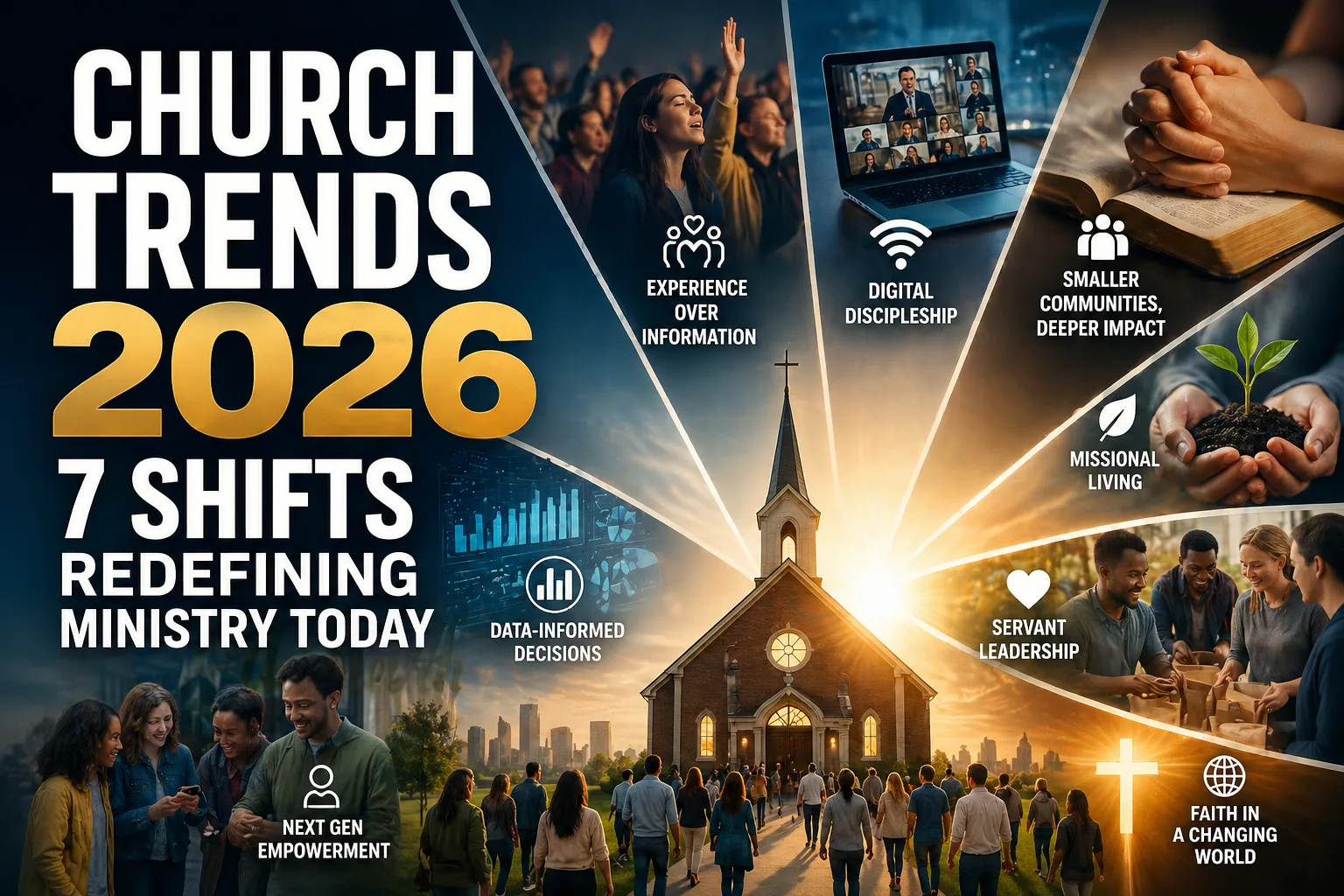
Church Trends 2026: Seven Shifts Redefining Ministry Today
The church trends 2026 landscape reveals something striking. We're not just tweaking methods anymore. We're watching foundational shifts in how believers gather, serve, and spread the gospel across every generation and geography.
These aren't predictions pulled from thin air. They're patterns already emerging in thousands of congregations worldwide. Moreover, they're forcing pastors and church leaders to rethink assumptions that have guided ministry for decades.
The Rise of Hybrid Church Communities
Physical church buildings still matter—there’s something powerful about gathering in person. But since the pandemic, the meaning of “church attendance” has clearly shifted.
Today, many churches are no longer choosing between in-person or online—they’re doing both, intentionally. Hybrid church has become the norm. In fact, for some congregations, the number of people tuning in online is just as large—or even larger—than those sitting in the pews.
That kind of shift calls for more than just a camera in the back of the room. Churches are now investing in better streaming setups, training online hosts, and creating real pathways for people to grow spiritually from wherever they are. It’s not just about broadcasting a service anymore—it’s about designing experiences that truly connect with people on the other side of a screen.
And this raises deeper questions than just technology. Scripture reminds us that the church is not a building—it’s people gathered in Jesus’ name, wherever that may be. Still, this new reality challenges leaders to think carefully about things like online communion, digital membership, and what genuine Christian community really looks like.
Building Digital Discipleship Pathways
In the past, discipleship was mostly face-to-face. You met over coffee, joined a small group nearby, and served together on Sundays.
Now, discipleship has to be reimagined. Churches are creating online small groups that aren’t limited by location but instead bring people together based on life stage, needs, or even time zones. Someone in a small town can now grow alongside believers from across the world.
That kind of reach is incredible—it expands the impact of the gospel in ways we’ve never seen before. But it also comes with a challenge: making sure those connections go deeper than surface-level interaction. Real fellowship still requires intention, vulnerability, and commitment—even through a screen.
Physical buildings still matter. However, the definition of "church attendance" has fundamentally changed since the pandemic forced digital experimentation.
Hybrid church models now dominate the landscape. Congregations simultaneously serve in-person attendees and online participants with equal intentionality. Furthermore, many churches report their online audience rivals or exceeds their physical attendance.
This shift demands new infrastructure. Churches invest in quality streaming equipment, dedicated online hosts, and digital discipleship pathways. Because people engage differently through screens, ministry teams develop content specifically for digital consumption rather than simply broadcasting services.
The theological implications run deeper than technology. Scripture reminds us that the church exists wherever believers gather in Christ's name. Consequently, church leaders now wrestle with questions about virtual communion, online membership, and what constitutes genuine community.
Digital discipleship looks very different from what many of us grew up with. It used to mean meeting up for coffee, gathering in small groups, and serving side by side at church on Sundays.
Now, it takes more intention. Churches are creating online small groups based on time zones instead of location. That means someone in rural Montana can build real relationships with believers across the world who are walking through similar seasons of life or facing the same struggles.
This kind of connection has the potential to expand God’s kingdom in powerful ways. But it also comes with a challenge—we have to be careful not to mistake quick, surface-level interactions for genuine, life-giving fellowship.
Generational Diversity as Strategic Priority
The generational divide in churches has reached crisis levels. Baby Boomers, Gen X, Millennials, and Gen Z don't just prefer different music styles—they process faith, authority, and community through fundamentally different frameworks.
Churches thriving in 2026 don't chase "relevance" by abandoning older generations. Instead, they create space for multiple expressions under one unified mission. For example, they might offer traditional services alongside contemporary gatherings while ensuring both generations serve together in outreach.
This approach requires humility from all sides. Older believers must release control over aesthetic preferences. Younger generations must honor the wisdom and sacrifice of those who preceded them. Above all, both groups must prioritize unity over comfort.
Reverse Mentoring Gains Momentum
The concept of reverse mentoring—where younger believers mentor older ones—is transforming church leadership dynamics. Gen Z members teach Boomers about social media evangelism. In return, seasoned saints share hard-won insights about endurance through suffering.
This mutual exchange strengthens the entire body. Moreover, it models the New Testament vision where every member contributes unique gifts regardless of age or tenure.
Mental Health Integration in Ministry
The mental health crisis has infiltrated every pew. Depression, anxiety, and trauma no longer hide in shadows while churches pretend brokenness doesn't exist among the redeemed.
Progressive churches in 2026 integrate mental health support directly into ministry infrastructure. They employ licensed counselors on staff, train small group leaders in mental health first aid, and preach openly about psychological struggles without reducing them to simple sin issues.
This integration doesn't replace the gospel's power. Instead, it acknowledges that humans are complex beings whose neurochemistry, traumatic experiences, and spiritual realities interconnect. Research from Christianity.com demonstrates that addressing mental health actually strengthens discipleship outcomes rather than competing with spiritual formation.
Breaking the Stigma Through Testimony
Silence perpetuates shame. Churches breaking new ground in 2026 create platforms where leaders vulnerably share their own mental health journeys.
Pastors preach about their battles with depression. Worship leaders discuss anxiety medication. Consequently, congregants feel permission to seek help rather than white-knuckling through crises while maintaining spiritual facades.
This authenticity doesn't undermine pastoral authority. Rather, it demonstrates that Christian maturity includes acknowledging limitations and pursuing wholeness through multiple means—prayer, medication, therapy, and community support.
Decentralized Leadership Structures
The era of the celebrity senior pastor is starting to crack. Between public scandals, deep burnout, and a growing rethinking of church leadership, people are seeing the risks of placing too much power in one charismatic figure.
In response, many churches are shifting toward healthier models. Instead of everything flowing from one person’s vision, leadership is being shared among elders, ministry leaders, and everyday members who are empowered to serve. Decisions are made together, with multiple voices at the table.
This kind of structure tends to be more stable. When leadership changes—or even when a leader falls—the church doesn’t fall apart with them.
It also looks a lot more like the New Testament church. Early believers didn’t revolve around a single personality. Leadership was shared, elders worked together, and every person had a role to play in the body.
Empowering Bivocational Ministry
Over time, ministry started to feel like a one-person job that no one person could realistically sustain. Pastors were expected to preach powerful sermons, counsel people through life’s struggles, manage church operations, cast vision, and lead the community—all while often living on limited income. That kind of pressure isn’t just heavy; it’s unrealistic.
That’s why bivocational ministry is becoming a meaningful alternative. Like Paul, who made tents while preaching the gospel, many pastors today are working regular jobs alongside leading their churches. This approach brings financial stability, keeps them connected to everyday people outside the church, and reduces the pressure to depend on the congregation for everything.
It also changes how ministry functions within the church. When the pastor can’t carry it all, others begin to step in. People start using their gifts, serving one another, and taking ownership of their faith. Instead of just attending services, the whole body becomes active and engaged.
Mission-Focused Budget Allocation
Financial priorities reveal true values. Churches in 2026 face increasing pressure to redirect budgets away from buildings and staff toward mission and community impact.
This shift doesn't mean abandoning facility maintenance or fair compensation. However, it does mean scrutinizing every expense through a mission lens. Many churches now allocate 40-50% of budgets to external ministry rather than internal operations.
These churches ask uncomfortable questions. Do we need this building expansion or could that money plant three churches in unreached neighborhoods? Should we hire another staff member or invest in marketplace ministry training for our members?
Transparency in Financial Stewardship
Financial scandals have caused many people to lose trust in church leadership. Because of this, some churches are choosing a different path—one rooted in openness and honesty. They openly share their budgets, salaries, and how money is being spent, making this information available to everyone in the congregation. They take time to explain how compensation is decided and welcome questions about where resources are going. Many even bring in independent audits, even when it’s not required.
This kind of transparency helps rebuild trust. It shows integrity in action, protects leaders from unnecessary suspicion, and guards the church community against real financial misuse.
Justice and Mercy as Core Identity
Church trends in 2026 are making one thing clear: engaging in social justice isn’t optional anymore—especially for churches that want to connect with younger generations and truly reflect the heart of the Bible.
More churches are no longer treating justice as a side ministry. Instead, they’re weaving it into who they are. Issues like racial reconciliation, poverty, immigration, and human trafficking aren’t being pushed aside as “political”—they’re being embraced as part of the gospel itself. After all, when people are hurting or oppressed, a message of hope without action can feel empty.
At the same time, this shift requires wisdom and balance. Churches have to stay rooted in Scripture, not drift into purely cultural or political agendas. It’s not about choosing between evangelism and justice—it’s about holding both together. Sharing the gospel and standing up for people should go hand in hand.
At the core of it all is this truth: caring for “the least of these” isn’t about politics—it’s about living out genuine faith and reflecting the love of Christ in a real, visible way.
Partnerships Over Programs
Effective justice ministry doesn’t thrive in isolation. In 2026, more churches are choosing to partner with trusted organizations instead of trying to build everything from the ground up. They come alongside nonprofits already doing meaningful work in areas like homelessness, foster care, refugee support, and addiction recovery.
By doing this, churches tap into existing expertise while offering what they have—people, resources, and compassion. It creates a powerful synergy where everyone plays their part. Instead of carrying the heavy weight of running complex programs alone, churches can focus on showing up, serving well, and making a real difference. This kind of partnership doesn’t just help—it multiplies impact.
Theological Depth Amid Cultural Chaos
Superficial Christianity doesn’t hold up when culture starts pushing back. In 2026, believers are facing real, complicated questions—about technology, sexuality, politics, and how to live in a world full of different beliefs. These aren’t issues you can answer with quick slogans or surface-level faith.
Churches that are actually helping people grow are going deeper. They’re creating space for honest Bible study, where hard passages aren’t avoided but wrestled with. They’re teaching church history so believers can see how others stood firm in challenging times. And instead of just echoing political opinions, they’re helping people think biblically and develop convictions rooted in truth.
That kind of foundation builds strong, steady faith. It produces believers who can step into culture without losing their identity or withdrawing in fear. They can speak with both clarity and grace—holding onto truth while still reaching people with love.
Catechesis Makes a Comeback
Ancient practices are making a quiet comeback—and they’re more relevant than ever. Catechism, the age-old method of teaching Christian beliefs through simple question-and-answer formats, is gaining fresh attention across many denominations.
Churches are using catechisms to help new believers and children build a strong spiritual foundation. It gives them a shared language for understanding Scripture, salvation, and how to live out their faith. Because of that, congregations are finding deeper unity around what truly matters, even when they don’t agree on everything else.
This renewed interest shows that church trends in 2026 aren’t just about new ideas—they’re also about rediscovering wisdom that’s been there all along. Resources like Got Questions are helping bridge that gap, connecting timeless biblical truth with the real questions people are asking today.
Short-Term Missions Reimagined
The old model of short-term mission trips is starting to get a lot of pushback. For years, churches would send groups—often teenagers—across the world to build things that local workers could’ve done better and faster. In many cases, it ended up being more about the experience for Americans than making a real, lasting impact for God’s kingdom.
Now, in 2026, more churches are rethinking what missions should look like. Instead of quick trips, they’re focusing on long-term relationships. They’re partnering with local leaders, supporting ministries that are already doing the work, and investing in people who understand their own communities best.
When teams do travel, it’s no longer about coming in as “helpers” or trying to fix things. It’s about listening, learning, and building genuine relationships. The goal isn’t to play the hero or capture perfect photos—it’s to come back home with a deeper understanding of the global Church and become advocates who support what God is already doing around the world.
Diaspora Ministry as Mission Field
Global migration patterns have brought the mission field to Western doorsteps. Churches recognizing this opportunity intentionally reach immigrant communities in their cities.
They offer English classes, legal assistance, and hospitality to refugees and immigrants. Moreover, they partner with diaspora believers whose cultural fluency enables more effective outreach to their own communities. This approach builds kingdom diversity while addressing real community needs.
Conclusion
The church trends 2026 landscape reveals both challenge and opportunity. These seven shifts—hybrid community, generational diversity, mental health integration, decentralized leadership, mission-focused budgets, justice engagement, and theological depth—are reshaping how we embody Christ's church.
These trends don't represent compromise with culture. Instead, they reflect the church's perennial call to remain faithful to unchanging truth while adapting methods to reach changing contexts. Because the gospel never changes, our flexibility in application demonstrates faithfulness rather than drift.
Church leaders feeling overwhelmed by these shifts should remember that God's Spirit guides His church through every generation. Therefore, we move forward with confidence that the gates of hell will not prevail against the church Christ is building.
The question isn't whether your church will navigate these trends perfectly. Rather, it's whether you'll engage them thoughtfully, Scripturally, and courageously. The watching world needs to see a church that's both ancient and fresh, rooted and relevant, convicted and compassionate.
These aren't merely organizational adjustments. They're opportunities to more fully express the kingdom of God in broken communities desperate for good news. Consequently, every shift represents invitation rather than threat.
Your church's specific response will reflect your context, convictions, and calling. However, ignoring these patterns won't make them disappear. Engage them wisely, and you'll position your congregation to thrive rather than merely survive the decade ahead.